Can A Woman Give Birth Vaginally After Coccygectomy?
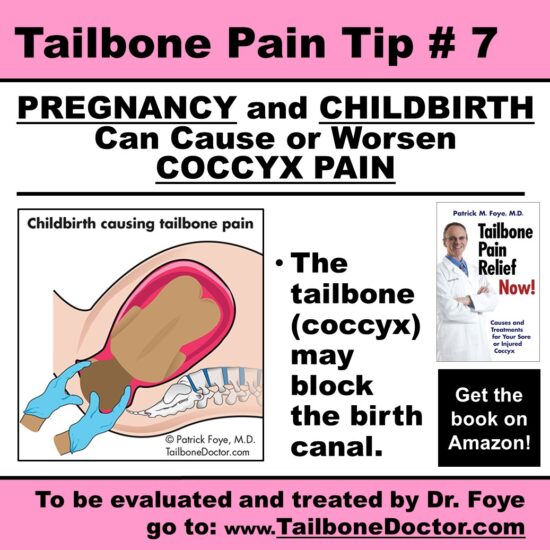
Giving birth to vaginally can cause or worsen coccyx pain (tailbone pain, coccydynia).
During childbirth for a vaginal delivery, the baby passes through the birth canal, which can cause pressure and trauma onto the coccyx.
Recently I was asked whether giving birth to vaginally would be likely to worsen the tailbone pain in a woman who had previously undergone coccygectomy (surgical amputation or removal of the coccyx, tailbone)
Theoretically, if a person’s coccyx was removed, it is therefore “out of the way” and no longer obstruct the birth canal.
Still, most people have some degree of ongoing discomfort/pain in the coccyx area even after coccygectomy. So there is a risk that pregnancy and especially giving birth can make the pain even worse.
Certainly no one can guarantee whether a vaginal delivery will or will not flare-up a given individual’s pain, even after coccygectomy.
I do not know of any published study showing how patients do with giving birth vaginally after coccygectomy, so there is not really any substantial research-based data upon which a given person can make their decision.
So some of the decision comes down to what makes the most sense for a given woman.
For my own patients, if someone had a coccygectomy and is now considering giving birth vaginally, I generally use their current level of coccyx pain as a ballpark indicator of how much risk there would be for the vaginal delivery flaring up the pain in that area.
(If the pain in the coccygectomy area is already pretty bad, then most likely the labor/delivery will make it even worse, in which case it may make sense to consider delivering via C-section [cesarean section]. Alternatively, if the patient had an excellent outcome after coccygectomy and has had multiple years with little or no pain in that area, then they probably have a significantly better chance of delivering vaginally without a substantial flareup, although of course there are no guarantees.)
There is no one “right” answer that will work for *all* patients.
Each patient needs to discuss the options with their in-person treating physicians.
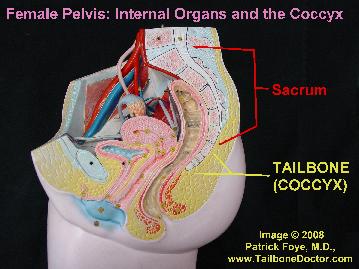
Female Pelvis, showing the Uterus, Sacrum, Coccyx, Tailbone, etc.
GET THE BOOK: To get your copy of the book “Tailbone Pain Relief Now!” go to: www.TailboneBook.com or go to Amazon.
COME FOR RELIEF: For more information on coccyx pain, or to be evaluated in-person at Dr. Foye’s Tailbone Pain Center in the United States, go to: www.TailboneDoctor.com
– Patrick Foye, M.D., Director of the Coccyx Pain Center, New Jersey, United States.
Tailbone Pain Tip 7, PREGNANCY and CHILDBIRTH Can Cause or Worsen COCCYX PAIN, Tailbone Pain, Coccydynia
Many people ask me why their coccyx x-rays (tailbone x-rays) looked totally normal even though they’re suffering from severe coccyx pain (tailbone pain, coccydynia).
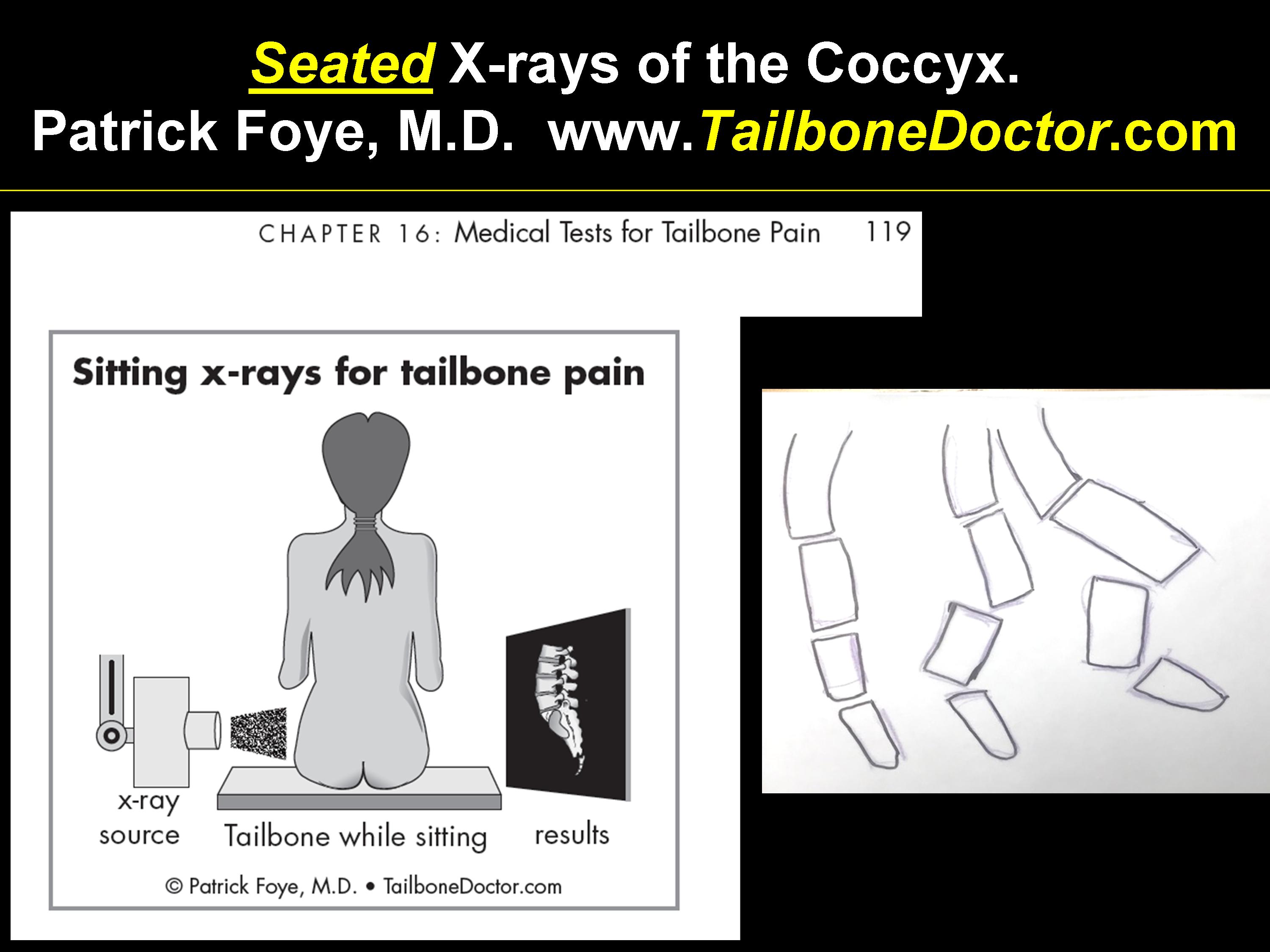
Usually, the answer is that unfortunately their previous x-rays did not include any evaluation of the coccyx bones while they were sitting.
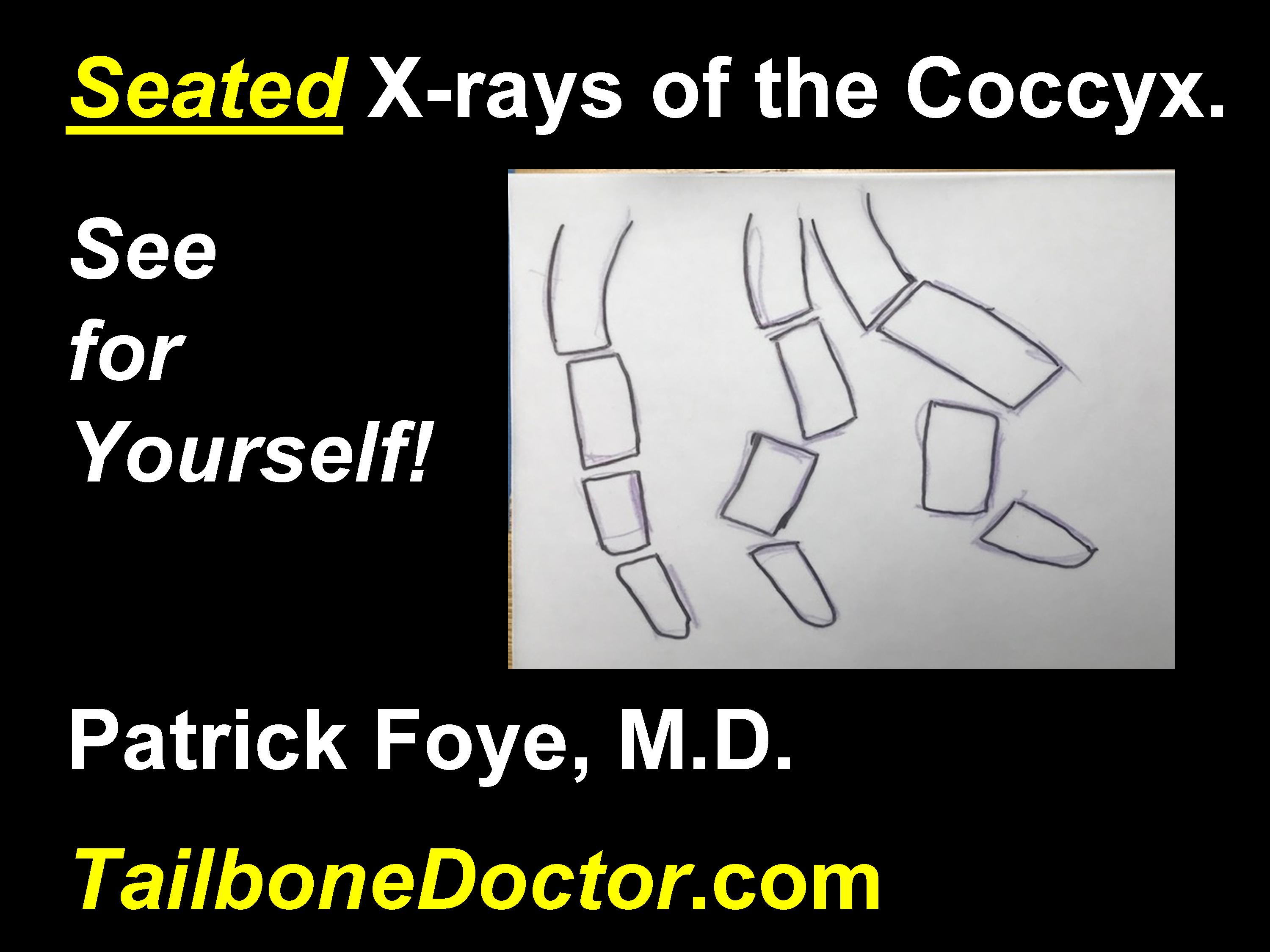
This video shows an example of actual x-rays where the routine coccyx x-rays (done while standing) were normal, but the seated x-rays showed a severe 100% dislocation.
Here is the video link:
Here are some screenshot images from the video:
Tailbone Sit-Stand Xrays, See For Yourself. Seated x-rays for coccyx pain, tailbone pain, coccydynia.
Sit-Stand X-rays show SEVERE Dislocation only seen on SEATED xrays done for tailbone pain, coccyx pain, coccydynia
GET THE BOOK: To get your copy of the book “Tailbone Pain Relief Now!” go to: www.TailboneBook.com or go to Amazon.
COME FOR RELIEF: For more information on coccyx pain, or to be evaluated in-person at Dr. Foye’s Tailbone Pain Center in the United States, go to: www.TailboneDoctor.com
– Patrick Foye, M.D., Director of the Coccyx Pain Center, New Jersey, United States.
I was recently asked how do physicians distinguish between pudendal nerve pain (also called “pudendal neuralgia”) and coccyx pain (also called tailbone pain, or coccydynia). Below is a very, very brief overview.
Genital involvement:
Pudendal nerve pain usually involves the genitalia region, whereas coccyx pain usually does not.
Genital symptoms may include pain, numbness or tingling. In males, these symptoms may occur at the scrotum and/or penis. In females, these symptoms may occur
Right, Left, or Midline:
Pudendal nerve pain is often unilateral, meaning that it often involves only one side of the pelvic. For example, it often involves only the right side or only the left side. (Still, some cases of pudendal nerve pain can be bilateral, meaning that both right and left are involved.
Tailbone tenderness on physical exam:
Pudendal nerve pain usually has no significant tenderness at the coccyx during coccyx palpation on physical exam, whereas coccyx pain usually does have focal tenderness at the coccyx during coccyx palpation on physical exam.
Location of the pain/symptoms compared with the location of the anus:
Tailbone pain is located slightly above/behind the anus.
Pudendal nerve pain is located in front of the anus. (Basically, pudendal nerve symptoms can involve the anus or forwards from there.)
Pain with sitting:
This is an area of similarity between coccyx pain and pudendal nerve pain. Both of these conditions are often worse with sitting, and especially they are usually worse with sitting on a bicycle seat. Both are usually less painful sitting on a toilet seat rather than on a bicycle seat.
GET THE BOOK: To get your copy of the book “Tailbone Pain Relief Now!” go to: www.TailboneBook.com or go to Amazon.
COME FOR RELIEF: For more information on coccyx pain, or to be evaluated in-person at Dr. Foye’s Tailbone Pain Center in the United States, go to: www.TailboneDoctor.com
– Patrick Foye, M.D., Director of the Coccyx Pain Center, New Jersey, United States.
As part of Tailbone Pain Awareness Day, Patrick Foye, M.D., did more than one and a half hours live on Facebook answering questions about tailbone pain (coccyx pain, coccydynia).
The video is on the Facebook page for the Tailbone Pain Center:
Tailbone Pain Awareness Day, Patrick Foye MD answered Live Questions about Tailbone Pain, Coccyx Pain, on Facebook Live
GET THE BOOK: To get your copy of the book “Tailbone Pain Relief Now!” go to: www.TailboneBook.com or go to Amazon.
COME FOR RELIEF: For more information on coccyx pain, or to be evaluated in-person at Dr. Foye’s Tailbone Pain Center in the United States, go to: www.TailboneDoctor.com
– Patrick Foye, M.D., Director of the Coccyx Pain Center, New Jersey, United States.
Act now to get your FREE copy of the book, “Tailbone Pain Relief Now!”
Today is Tailbone Pain Awareness Day, November 15, 2018.
So, worldwide, you can get my book for FREE through Amazon for the next day or so.
Follow These 3 Simple Steps:
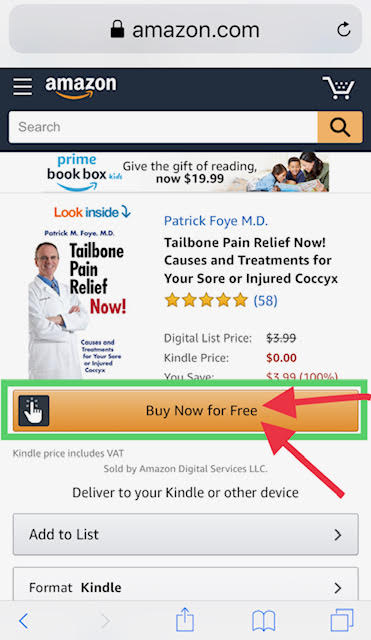
1) Go to Amazon for your country and search for: Tailbone Foye. (If you use a Kindle then you can also search for it directly from your Kindle. But you do not need a Kindle to receive or read the free book.) In the United States use this link: http://a.co/9ans5Vr
2) Select my book and above the price click on the line that says “see all versions”, to select the electronic version (the e-book, which is the version that is free).
FREE Book, Select it on Amazon, for Tailbone Pain Awareness Day
3) Download the electronic version of the book for free. Read it to learn more about the best tests and treatments for tailbone pain (coccyx pain). Once you have downloaded it, it should remain on you computer or e-book reading device.
Tips:
If you don’t already have a copy, this is your chance to get it for FREE.
Even if you already have the printed, paper version, you should log in to Amazon now and also get the electronic version.
If you want the paper/printed version, that is available for purchase.
Special Request from Dr. Foye:
Please post a REVIEW of this book on Amazon. I appreciate your feedback and your review can help others who are also suffering from this condition, so that they can find the book and find answers/relief. CLICK HERE to post a Review on Amazon.
Learn about Tailbone Pain Awareness Day, which is Thursday, November 15, 2015.
For a very limited time, you can get a free copy of Dr. Foye’s book, Tailbone Pain Relief Now!
Tailbone Pain Awareness Day, Nov. 15, 2018, Free Book
Free e-book, Tailbone Pain Relief Now, by Patrick Foye MD
GET THE BOOK: To get your copy of the book “Tailbone Pain Relief Now!” go to: www.TailboneBook.com or go to Amazon.
COME FOR RELIEF: For more information on coccyx pain, or to be evaluated in-person at Dr. Foye’s Tailbone Pain Center in the United States, go to: www.TailboneDoctor.com
– Patrick Foye, M.D., Director of the Coccyx Pain Center, New Jersey, United States.
The goal of Tailbone Pain Awareness Day is to draw attention to tailbone pain (also called coccyx pain), and to offer educational materials, support, understanding, and compassion for people suffering from tailbone pain.
Goals also include providing useful educational materials for people suffering from tailbone pain and for their treating clinicians (who, unfortunately, often do not have much expertise in treating tailbone problems).
History of Tailbone Pain Awareness Day:
Tailbone Pain Awareness Day is an internationally-recognized day, November 15, each year.
The first such day was started in 2018 by Patrick Foye, M.D., Director of the Tailbone Pain Center at Rutgers New Jersey Medical School in the United States. After evaluating and treating thousands of patients with tailbone pain over the prior 20 years, Dr. Foye initiated this campaign to shed light on this condition which is so commonly misunderstood, under-diagnosed, under-treated, and under-appreciated.
Tailbone Pain Awareness Day, Nov. 15, 2018, Free Book
Dr. Foye choose November 15 based on math:
Dr. Foye choose November 15 based on mathematically calculating what percent of the spinal vertebral bones were represented by the coccyx at the end of the spine.
The human spine (vertebral column) is made up of a series of vertebral bones stacked up one on top of the other. The number of vertebral bones varies based on each region of the spine. The cervical spine (neck) has 7 vertebral bones. The thoracic spine has 12. The lumbar spine has 5. The sacrum has 5. The coccyx has 3-to-5 (average is 4).
This means that there are typically 33 vertebral bones in the human spine: 29 above the coccyx and 4 at the coccyx. That makes 29 + 4 = 33 spinal bones in total.
Ignoring the coccyx (which, unfortunately, many clinicians do) means focusing only on 29 of the 33 spinal bones, which is about 87%.
So, ignoring the coccyx means ignoring the lowest 13% of the human spine.
Similarly, this would be like ignoring the last 13% of the calendar year. So…. that would be like ignoring the part of the year after November 15. Imagine all the holidays, festivities, gatherings, etc. that you would miss out on if your year ended on November 15!
GET THE BOOK: To get your copy of the book “Tailbone Pain Relief Now!” go to: www.TailboneBook.com or go to Amazon.
COME FOR RELIEF: For more information on coccyx pain, or to be evaluated in-person at Dr. Foye’s Tailbone Pain Center in the United States, go to: www.TailboneDoctor.com
– Patrick Foye, M.D., Director of the Coccyx Pain Center, New Jersey, United States.
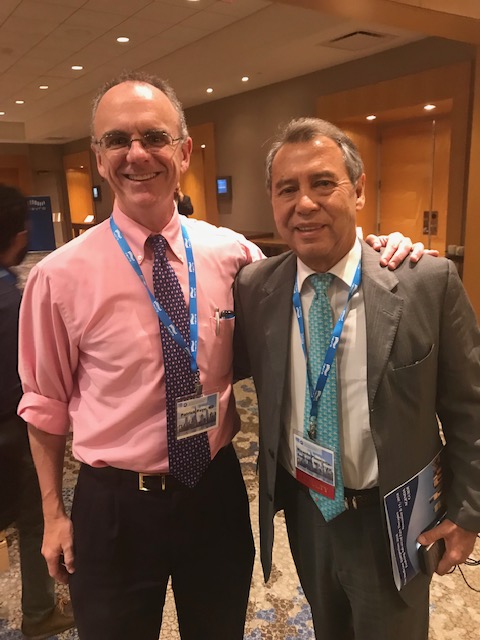
It was great to once again see Ricardo Plancarte Sanchez, MD, at the Pain Symposium held by the New Jersey Society of Interventional Pain Physicians and New York Society of Interventional Pain Physicians. (NJSIPP and NYSIPP)
“Pain Medicine Symposium 2018” was held in Jersey City, New Jersey, United States, in November 2018.
Dr. Plancarte has published and lectured extensively throughout his medical career, thus contributing to many pain physicians and the patients that we treat. Dr. Plancarte is based in Mexico, but lectures internationally. I am very very grateful for his contributions to the field of Pain Management.
Patrick Foye MD with Ricardo Plancarte Sanchez, MD, 2018. Dr. Plancarte originated Ganglion Impar Injections, which he first published in 1990. Dr. Foye has published 3 alternative techniques for performing these nerve blocks. Shown here together at NYSIPP-NJSIPP Pain Symposium, 2018.
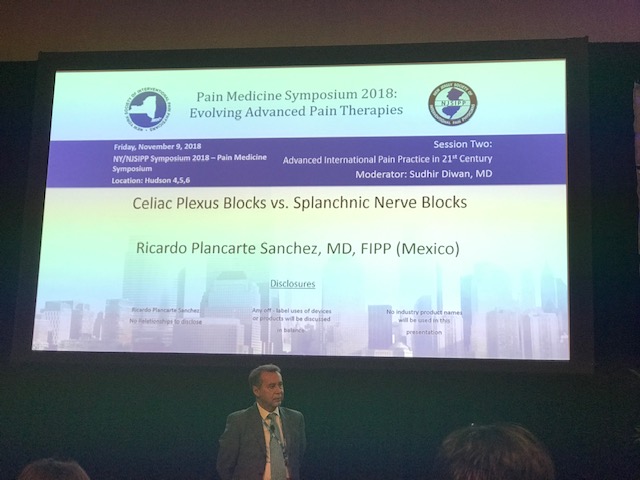
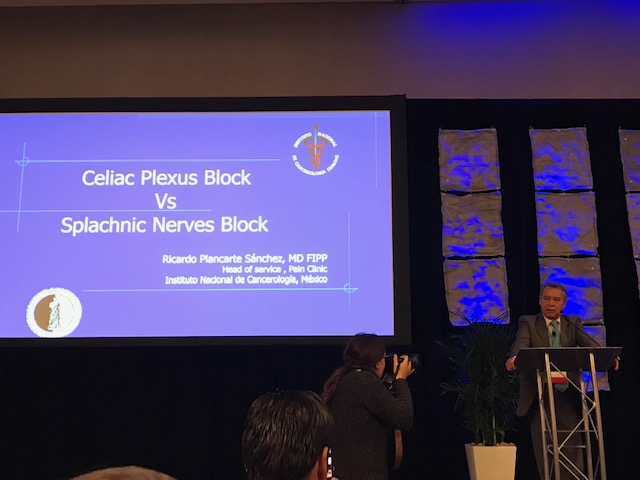
Dr. Plancarte Lectured on Celiac Plexus and Splanchnic Nerve Blocks
Dr. Plancarte Lectured on Celiac Plexus blocks and Splanchnic Nerve Blocks