 Patrick M Foye MD, Business Card, Tailbone Pain Center, Rutgers New Jersey Medical School
Now available: 4 Free Chapters, from Dr. Foye’s internationally acclaimed book, Tailbone Pain Relief Now!
Right now on Amazon you can get the first 4 chapters of this book for FREE.
- Chapter 1: Introduction to Tailbone Pain
- Chapter 2: Symptoms of Tailbone Pain
- Chapter 3: Overcoming Stigma: Psychology of Tailbone Pain
- Chapter 4: Anatomy of Tailbone Pain
- The full book contains 31 chapters, 272 pages, providing crucial information for people suffering from tailbone pain (coccyx pain).
- It is written in plain language, so it is easy to understand.
- The book has an impressive 5-star rating by readers on Amazon.
Get your 4 free chapters now.
- Then you can decide whether you also want a full copy of the book in the format of your choice: either as a printed paperback or as an e-book.
- Available internationally.
Learn the tips, tricks, and secrets you need to get an accurate diagnosis and the best possible treatments.
 Look-Inside Tailbone Pain Book, Coccyx Pain Book To come to Dr. Foye’s Tailbone Pain Center:
Tailbone Pain Book:
To get your copy of Dr. Foye’s book, “Tailbone Pain Relief Now!” click on this link: www.TailbonePainBook.com
 Book: “Tailbone Pain Relief Now! Causes and Treatments for Your Sore or Injured Coccyx” by Patrick Foye, M.D.
Tailbone Injections and Repeat Injections are Common and Reasonable for Coccyx Pain
REPEAT Tailbone Injections for Coccyx Pain
- The best reason to repeat a tailbone injection is when the same injection has previously provided excellent relief for a substantial duration of time.
- For example, if an specific injection gave 100% relief but then a year later the pain starts coming back, then repeating the injection often makes sense.
- Second dose: In some patients, the initial injection may fail to give adequate relief, but it still may make sense to REPEAT the injection.
- This is sometimes referred to as the “2nd dose” effect.
- Headache comparison: Imagine that you have a headache, and you take 2 tablets of Tylenol. After 4 or 5 hours, if you do not have complete relief of your headache, then it may be reasonable to take a “second dose”. The same treatment is given, but this may be dramatically more effective than the initial treatment was.
- At the coccyx, imagine that you had a coccyx injection, and received only partial relief, or perhaps even no relief at all. Then, depending on your specific details, it may make sense to REPEAT the same injection, in order to obtain the “Second dose” effect and thereby receive relief. It is often very dramatic to see patients where a single injection has given little or no relief, and yet a repeat injection (second dose) has given complete relief and terrific improvement in quality of life.
- The decision regarding whether to undergo or repeat a coccyx injection in any given patient should be a consideration and discussion between the individual patient and their in-person treating physician (ideally a physician with experience in evaluating and treating patients with coccydynia [coccyx pain, tailbone pain]).
For more information on tailbone pain, go to: https://tailbonedoctor.com
To come to Dr. Foye’s Tailbone Pain Center:
Tailbone Pain Book:
To get your copy of Dr. Foye’s book, “Tailbone Pain Relief Now!” click on this link: www.TailbonePainBook.com
Book: “Tailbone Pain Relief Now! Causes and Treatments for Your Sore or Injured Coccyx” by Patrick Foye, M.D.
2017 Appreciation Award Given to Dr. Patrick Foye, M.D.
- At this year’s graduation ceremonies for graduating residents physicians and fellows, the Department of Physical Medicine and Rehabilitation at Rutgers New Jersey Medical School presented the Department’s “Appreciation Award” to Dr. Foye, in honor of his almost-five-years serving as Interim Chair of the Department.

To come to Dr. Foye’s Tailbone Pain Center:
Tailbone Pain Book:
To get your copy of Dr. Foye’s book, “Tailbone Pain Relief Now!” click on this link: www.TailbonePainBook.com
Book: “Tailbone Pain Relief Now! Causes and Treatments for Your Sore or Injured Coccyx” by Patrick Foye, M.D.
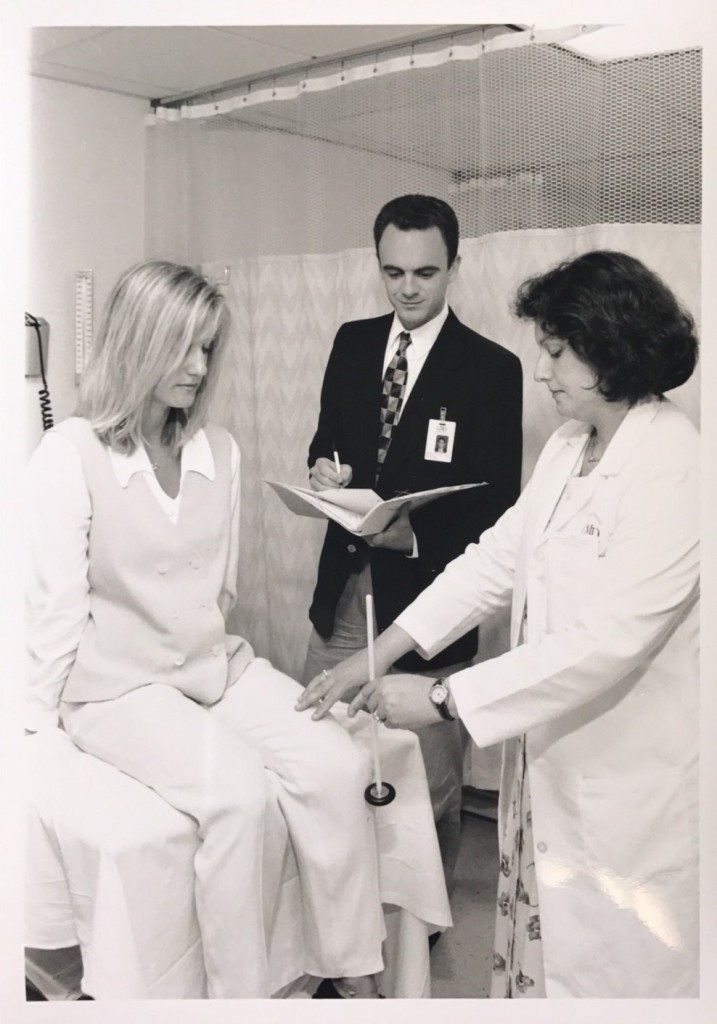
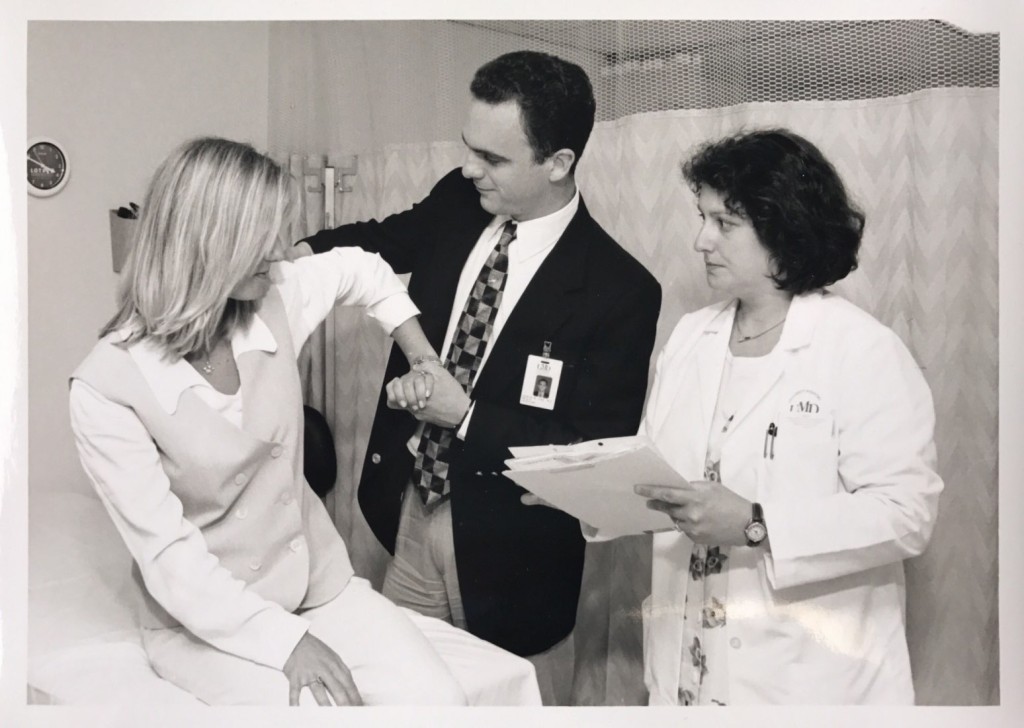
Photos from ~20 years ago
- #FBF (Flash-back Friday)
- with Dr. Denise Campagnolo (she was #NJMS/Kessler #PMandR Residency Director in that era).
- I found these today.
- But I’m not sure who that guy is with the thick, dark, hair. 🙂 -Dr. Foye
Unboxing a New Publication on Tailbone Pain, Coccyx Pain, Pelvic Pain
- Publishing is an important part of any career in Academic Medicine.
- Publishing is how we share our research, our clinical pearls, our experience and expertise.
- Publishing makes all of this available to other clinicians, physicians, researchers, and others who may be interested worldwide, for years to come.
- The VIDEO below shows Patrick Foye, M.D., un-boxing a newly-received, freshly-minted copy of a new publication.
- The journal is called, “Physical Medicine and Rehabilitation Clinics of North America”.
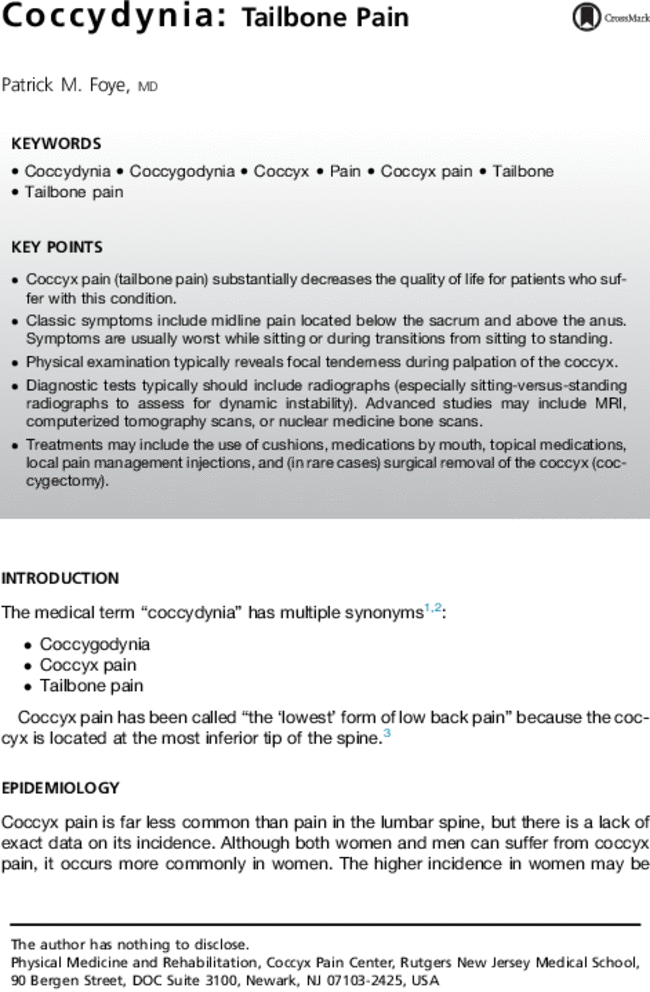
- This entire hardcover edition was dedicated to “Pelvic Pain” and Dr. Foye wrote the chapter on “Coccydynia: Tailbone Pain” (Coccyx Pain).
- To reveal the VIDEO, click on the images or click on the link below.
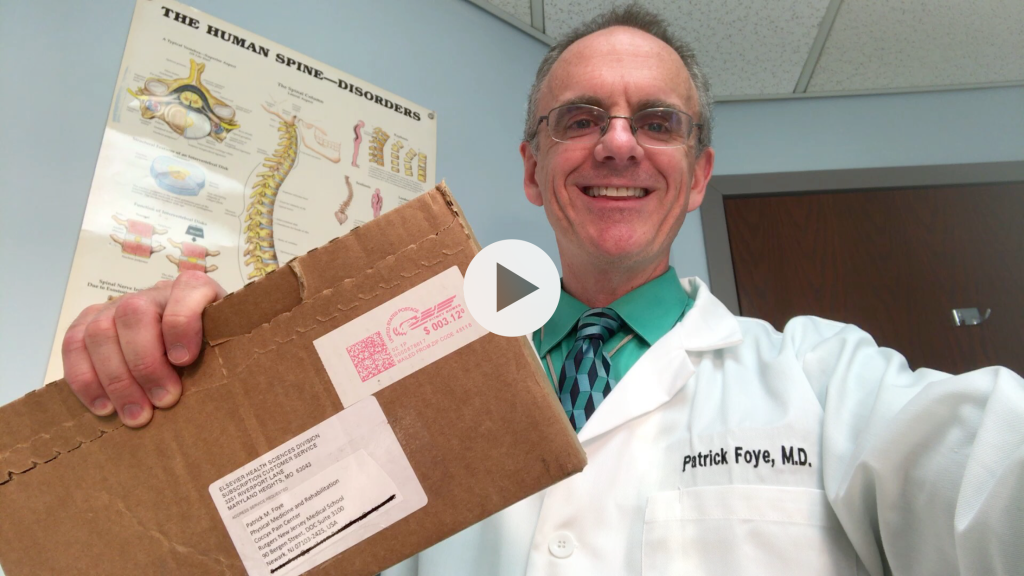 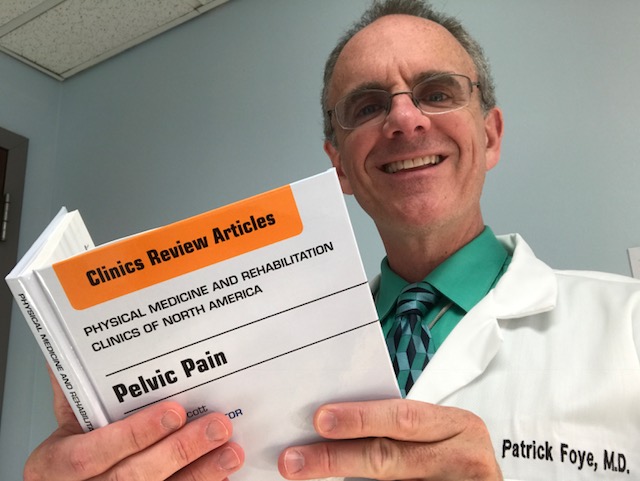 - To reveal the VIDEO, CLICK this LINK: https://youtu.be/mL0x2Ei4hx8
Below is the TEXT transcribed from Dr. Foye’s Video:
- I’m Dr.Patrick Foye, and I’m an M.D., or medical doctor, and I’m the Founder and Director of the Coccyx Pain Center or Tailbone Pain Center here in the United States, available online at www.TailboneDoctor.com.
- And the reason that I’m holding this cardboard box that arrived in the mail today is sort of an unboxing of sorts Some of you may know that in addition to treating patients I am a full-time faculty member here at Rutgers New Jersey Medical School, where I’m a Professor within the Department of Physical Medicine and Rehabilitation and being a Professor, and an academic faculty member, part of what that means is that, in addition to being a physician and treating patients, that I’m also a medical educator, that I’m teaching medical students and residents physicians and fellows and colleagues and also doing research and publications.
- And I probably have, I don’t know, easily over 100 publications (between research articles and book chapters and various publications over the years) which is not surprising given that I’ve been in academic medicine for more than twenty-one years.
- But the part that’s neat for me is that it’s still exciting, and I still love what I do, and I still love when I finally see something in print when I know that myself and my colleagues have been working on for a long time.
- So, the unboxing, of sorts… This arrived here at the Tailbone Pain Center here today and in opening it up it is basically the current addition of a journal called the Physical Medicine and Rehabilitation Clinics of North America.
- And they did an entire hardcover issue on pelvic pain specifically.
- And I was asked to write the section in here on coccyx pain or tailbone pain, since that’s my primary area.
- So I can tell you that for myself and the other physicians across the country who have been involved in this particular publication this has been at least well over two years in the making.
- Academic projects take a long time between the time you are invited to write an article or a paper or a manuscript or a book chapter and then doing the edits and going back and forth with the editors and sometimes with medical illustrators and then finally making it to publication and making it into print.
- It’s always cool when it finally comes out and you actually have a tangible copy, and the idea that this tangible copy is also showing up in other places that physicians are getting their hands on this and hopefully learning, in this case, the proper way to evaluate and treat tailbone pain.
- So within this, if I open it up here again: PM&R Clinics of North America, entire section on Pelvic Pain.
- There are lots of different authors from around the country doing their own different sections.
- There’s a section here on anatomy and physiology, office evaluation of pelvic pain in general, myofascial pain musculoskeletal pain and then the next chapter, which is mine, which is basically on coccyx pain.
- So if I swing back to that, I’ll share just a little bit with you of what’s in here for physicians.
- Now this is different than some of the things I’ve written and published more specifically for patients.
- I still continue to do that as well and I’m a huge believer in empowering patients.
- But this particular one is on is for is written for physicians.
- So if you have a physician who perhaps is a Physical Medicine and Rehabilitation doctor, this might be something that’s on their shelf.
- If you have tailbone pain you may want to ask them if they have received the pelvic pain edition of the PM&R clinics of North America journal, because there’ll be lots of information in there for them.
- And, again, in this particular chapter on coccydynia or tailbone pain.
- We talk in here about the terminology, how frequent this is, the anatomy, the different joints, ligaments, muscles, etc.
- that that attach to the tailbone.
- The different causes of tailbone pain.
- So here we’re talking about coccyx fractures, dislocations, coccygeal dynamic instability (which means an unstable joint at the tailbone, which is one of the most common causes of tailbone pain, and something that you really need sitting versus standing x-rays in order to evaluate for and make that diagnosis).
- Here I also talk about bone spurs at the lower tip of the tailbone (a common source of tailbone pain), abnormal positions of the coccyx, arthritis, sympathetic nervous system pain at the tailbone, pelvic floor dysfunction, cancer, bone infection, and lots of other things that can cause pain.
- It also educates doctors about the symptoms: pain with sitting being the most common and many patients will also have pain with sit-to-stand.
- They may have other pains in other back low back and pelvis and buttock regions as well.
- Here I mentioned about the physical exam findings to look for with tailbone pain, the diagnostic tests or imaging studies like x-rays and especially the sitting versus standing x-rays explaining to them what that is (because unfortunately many, many doctors around the country and around the world are not familiar with sitting versus standing x-rays for tailbone pain, which is really, really unfortunate because unstable joints are probably the most common cause of tailbone pain and they can only be diagnosed on imaging studies by doing the sitting versus standing images so those x-rays become really, really important).
- But I also talked about MRI and CT scans and nuclear medicine bone scans and other things in this section, which is within that area about diagnostic tests.
- I’ve also published… this is the first time I’ve published this particular algorithm, which is basically going from somebody that has pain and getting the x-rays (ideally the sitting versus standing x-rays) and then depending on what those show deciding whether the person needs to move forward with treatment versus whether they may need further imaging studies, such as MRI or CT scan or other things to look for malignancies and other conditions, depending on what your initial findings were on the initial X-rays.
- And then depending on how they respond to treatment deciding whether to circle back and if you didn’t get the advanced imaging studies (like MRI or CT scans) to consider those in those patients if they’re not getting the kind of initial relief or response.
- And then other things within treatment…
- everything from cushions to medications to
- Some of the interventional injections that can be done for tailbone pain are covered in here, from steroid injections to ganglion Impar sympathetic nerve blocks to nerve ablation.
- All of that, physical therapy and in surgical cases…
- coccygectomy, which is surgical removal of the tailbone.
- Fortunately that’s not necessary the majority of the time and is sort of something that’s done only when people have exhausted other measures.
- So, again, a lot of information packed in here for physicians.
- And hopefully, the goal really is to educate physicians so that they can be as knowledgeable and experienced as possible in evaluating and treating patients with pelvic pain and in my section for tailbone pain (coccyx pain) in particular.
- So hopefully that will be helpful for the physicians because then that will be helpful for their patients.
- So again this one medical journal mainly for physicians.
- I also have written an entire book much longer than what I have in here.
- It’s an entire book about tailbone pain.
- This one is written more for patients, or for people who are non-physicians, the people who are actually suffering with tailbone pain.
- So this one is 272 pages, all about the coccyx, covering in much more detail a lot of these things and written in layperson language, so you don’t need a medical degree by any means to read this book.
- You can find this on Amazon: you can get it as an ebook through Amazon, you can get the softcover copy through Amazon.
- At the time that I’m making this video you can still get a free copy (just pay shipping and handling) you can get that through www.TailboneBook.com.
- So lots of different ways to if you have tailbone pain and are looking for more information and looking to be empowered with knowledge, because then that helps you with knowing what makes sense in terms of evaluation or treatment.
- So again lots of information for physicians and also for patients.
- So hopefully spreading the word so that patients can get relief.
- Because a lot of people unfortunately suffer unnecessarily for long periods of time with tailbone pain because not a lot of Doc’s are familiar with how to treat it.
- If you’re looking for more information, certainly you can you can find me online at www.TailboneDoctor.com And if you have questions or comments certainly post them down below beneath the video and I’ll look forward to hearing from you and may be meeting some of you someday.
- All the best.
- Bye-bye now.
Here is the published abstract:
To come to Dr. Foye’s Tailbone Pain Center:
Tailbone Pain Book:
To get your copy of Dr. Foye’s book, “Tailbone Pain Relief Now!” click on this link: www.TailbonePainBook.com
Book: “Tailbone Pain Relief Now! Causes and Treatments for Your Sore or Injured Coccyx” by Patrick Foye, M.D.
Summarizing 21 Years as a Medical Doctor, Physician, Medical Educator, Clinician, at Rutgers New Jersey Medical School
- Patrick M. Foye, M.D. is a physician in New Jersey.
- On the anniversary date of being 21 years on faculty at Rutgers New Jersey Medical School, Dr. Patrick Foye gave his off the cuff thoughts.
- Looking forward hopefully to many more years of patient care and medical education! 🙂
- To reveal the VIDEO, click the image below, or click on the Link below:
 - Here is the Link to the Video: https://youtu.be/aEJM3peqEW4
Here is the TEXT transcribed from the video:
- I am Dr. Patrick Foye, and I’m an M.D., or medical doctor.
- And I’m making this video, particularly on the anniversary of my 21 years here on faculty at Rutgers New Jersey Medical School.
- I actually first came to the medical school longer than that ago, about 28 years ago, as a medical student and graduated from here in 1992, so about 25 years ago.
- Then I went and spent a couple of years working at a hospital in Chicago, doing my residency out there.
- I came back and joined the faculty here at what was then called “UMDNJ New Jersey Medical School” in August of 1996.
- And now here we are in August 2017, so 21 years later.
- So on the anniversary date of my joining the faculty here, it just gives me pause to think back at what the last 21 years here have meant.
- First of all, we are a medical school, so we are training medical students.
- So along those lines, we graduate approximately 160 to 180 medical students per year.
- So looking back at 21 years here, were are looking at ballpark of about 4,000 medical school graduates during my time here.
- And I’m actively involved in the medical school curriculum, teaching them musculoskeletal medicine and pain management and those kinds of things.
- So really I’ve had an opportunity to contribute to the knowledge base and hopefully the patient care skills for about 4,000 of our New Jersey medical school graduates who are out there making our school proud, doing terrific work in the clinical care for their patients, and healthcare administration, and research, and all kinds of other areas.
- We also have a highly esteemed residency training program in Physical Medicine and Rehabilitation, the medical school here and the Kessler Institute for Rehabilitation and our other affiliate sites.
- And that’s about another 8 to 10 graduates per year from the resident training program in PM&R, so another hundreds or a few hundred graduates from during my time here.
- And it’s really gratifying at this point of my career, having been doing this for couple of decades, to be able to see many of those graduates out there doing great things, some of them are residency program directors themselves and course directors and running conferences where I myself go and I’m learning things from them.
- And they’re publishing great articles, and of course doing terrific patient care in a wide variety of subspecialties and areas within Physical Medicine and Rehabilitation.
- And then certainly for myself in addition to the educational aspects of teaching our students, and our residents, and our fellows, is treating patients myself, which is certainly the most gratifying part of my time here.
- I do mostly all outpatient musculoskeletal medicine and pain management.
- My subspecialty niche area is treating patients with “tailbone pain” or “coccyx pain”.
- I run a Coccyx Pain Center or Tailbone Pain Center here.
- And that has been incredibly gratifying.
- To have patients who are suffering from pain and to be able to find an answer to what is causing their pain and then to be able help them find relief from the pain that their suffering with is immensely gratifying.
- Here on campus we also have University Hospital.
- It’s a “safety net” hospital.
- It’s a state hospital here in New Jersey.
- We treat lots of patients from near and far.
- It’s a Level-1 Trauma Center, so many, many serious injuries are brought here by helicopter and ambulance and all of those kinds of things.
- And it’s also a hospital that serves the needy.
- So we are the number 1 provider of charity care services of any medical facility within the state of New Jersey.
- And that’s really part of our mission here as well, taking care of patients who would not have access to medical care elsewhere.
- So, in general as I look back now on 21 years here it has been a terrific 21 years.
- I certainly have grown as a physician and as a person.
- I’m at a different stage in my life than when I started here.
- And I look back and think about the medical students and residents physician and fellows and my colleagues or attending physicians that I’ve gotten to work with, and the patients that I’ve been able to treat, and really it’s been a terrific 21 years.
- So, those are my thoughts on 21 years at New Jersey Medical School, here in Newark, New Jersey.
- Okay. Bye-bye.
To come to Dr. Foye’s Tailbone Pain Center:
Tailbone Pain Book:
To get your copy of Dr. Foye’s book, “Tailbone Pain Relief Now!” click on this link: www.TailbonePainBook.com
Book: “Tailbone Pain Relief Now! Causes and Treatments for Your Sore or Injured Coccyx” by Patrick Foye, M.D.
Medical imaging studies for Tailbone Pain
- Medical imaging studies can be very helpful in making an accurate diagnosis in patients with coccyx pain (also called coccydynia, or tailbone pain).
- The most common medical imaging studies for tailbone pain include:
- X-rays: especially “sitting-versus-standing” x-rays to look for “dynamic instability” ( unstable joints of the coccyx).
- MRI: Magnetic Residents Imaging.
- MRI is helpful at showing soft tissue structures such as pilonidal cysts, retrorectal cysts, abscess (an infected collection of fluid and pus).
- MRI is also helpful when looking for bone infection (osteomyelitis).
- MRI can help in evaluation for possible cancer (malignancy, such as chordoma, which is often fatal and has a tendency to occur at the sacrum and coccyx region).
- CT scans: also called “computerized tomography” scans.
- These can be helpful at showing details of the bone (e.g., the sacrum and coccyx).
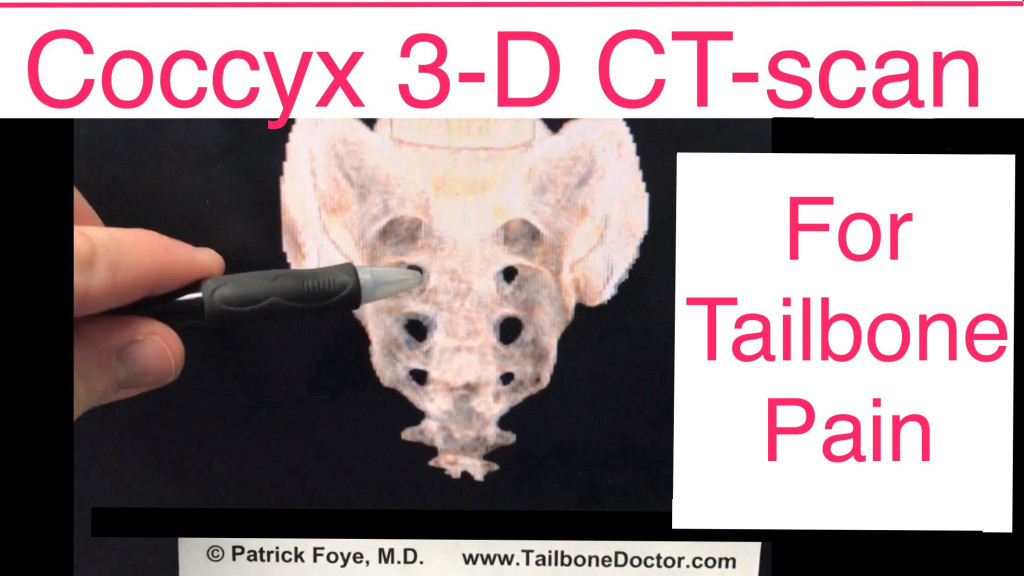
- 3-D ( “three-dimensional”) CT scan is a special type of CT scan, where the image can be rotated by the physician, as shown in the video below.
- It is relatively uncommon to need 3-D CT scans in patients with tailbone pain, but in properly chosen patients it can be a VERY helpful imaging test.
Here is Dr. Foye’s VIDEO teaching about 3-D CT scans for Tailbone Pain, Coccyx Pain:
Here is the TEXT from the video:
- OK, I am Dr. Patrick Foye and I’m an M.D., or medical doctor, and I’m Founder and Director of the Coccyx Pain Center or Tailbone Pain Center here in the United States.
- You can find me online at www.TailboneDoctor.com.
- This is just a short educational video on the topic of using CT scan (“cat scan” or computerized tomography scanning) in the evaluation of patients with tailbone pain and specifically the idea of using CT scan with three-dimensional reconstruction, which is what we’re looking at here for this particular individual.
- So the majority of times we are doing our imaging studies for patients with tailbone pain (or coccyx pain, coccydynia) the majority of times we’re using things like x-rays (medically we call those radiographs).
- So standard x-rays look at the tailbone, and especially x-rays done while the patient is sitting versus standing can be hugely helpful.
- In other patients we may need to do advanced imaging studies such as MRI to look at additional detail.
- But about 1% of the patients who I see for tailbone pain may benefit from what’s shown here which is a CT scan (a cat scan, computerized tomography scan) specifically with three-dimensional, or 3D, reconstruction.
- So rather than just having a static image (like one image or one or one slice) what’s done here is actually all of those slices are put together in a digital way, on the computer of course, so that the clinician or a physician can basically rotate the image in multiple directions.
- So I can go back and forth.
- And what that allows me to do is to look from many different angles at a given area, if there’s an area of interest or concern on the patient’s imaging studies.
- So just to sort of orient you here on this image…
- So this is the sacrum of this individual up in here, from about here down to about here, that’s the sacrum.
- The sacrum has these holes that you see in it.
- That’s normal.
- These are the sacral foramina which are the holes that the sacral nerves exits through.
- But then we get down to here which is the coccyx or tailbone.
- And one thing that’s particularly interesting here is that in this particular individual you can see that instead of coming to or sort of tapering down to a single point right at the midline…
- we’re going to rotate this and you can see here that this person actually has two different prongs or points that come down rather than just one at the midline.
- So this is somebody who has what’s called a “bifid” (B-I-F-I-D) coccyx or a “bifurcated” coccyx is another name or word for that.
- Really just that describes this anatomical variation where instead of the tailbone coming down to one single point in the midline, instead it splits into a point that comes down on the right and a point that comes down on the left, as shown here.
- This becomes important because if we were looking at this on x-ray…
- well x-ray looking at the x-ray that would be taken face-on (which is called an AP view) a lot of times the AP view of the tailbone is blocked or obscured or made fuzzy because of the structures that are right in front of it blocking the view: so the rectum, the colon, other parts of the organs within the pelvis are there.
- And they can basically (and stool within the within the colon) can make it difficult to see that lower part of the tailbone well on that view on an x-ray.
- But then you go to the side view on the x-ray, which would look something like this (not quite, but similar) and you can see here that because of those two prongs down there, because one is overlapping on top of the other we’re not able to see the space in between them.
- We would have no way to know that there were two separate prongs.
- We would think from this view because they’re overlapping.
- Just like if you were looking at my fingers you’d see two of them here versus now if you really just see one you know what looks like just one finger.
- Whereas being able to rotate brings it out to where you can see the two.
- So the same type of thing here.
- You can see it looks like just one solid lower part of the tailbone.
- But being able to rotate it now we can see that there’s actually two prongs or portions coming down.
- So that becomes really interesting and important because in some patients we see an atomic variations.
- If we’re not sure why we’re not seeing the tailbone appearance in the typical fashion in the lower part of the coccyx, then one of the things that physicians would be concerned about would be whether or not this may represent a malignancy (a cancer) of the tailbone region, such as chordoma, which unfortunately is highly fatal.
- And having a CT scan with 3-D reconstruction like this allows me to rotate the image, bit by bit like this, to look for multiple different angles on the computer screen like this.
- So that, again, I can see from multiple different points of view and decide whether this is just an anatomic variation similar to the way again just rotating my fingers here allows me to see that there’s two fingers rather than just one.
- And the other thing that it allows is that knowing that it’s an anatomic variation then we can move forward with regular treatment of the condition here.
- Or, on the other hand, if this was a malignancy well then we would move forward with getting appropriate further workup or treatment for that.
- So, again, this is maybe one percent of patients who I see for tailbone pain here at the Tailbone Pain Center that I end up ordering this type of study who the CT scan with three-dimensional or 3d reconstruction.
- It’s very cool technology.
- But I only use it in very selected cases who have a specific question anatomically that we were unable to answer from the regular imaging studies (such as x-rays and MRI).
- So that’s all for this.
- This is an educational video, so this is not specific medical advice for any specific individual person or patient.
- For that you would of course seek in-person consultation with your own treating physician.
- If you’re looking for more information on the topic of tailbone pain or coccyx pain certainly you can visit me online at TailboneDoctor.com or on Facebook/TailbonePainCenter.
- So that’s all for now.
- I hope this was helpful.
- If you have questions or comments please feel free to post them down below.
- Bye bye.
For more information on Tailbone Pain, Coccyx Pain: go to www.TailboneDoctor.com
To come to Dr. Foye’s Tailbone Pain Center:
Tailbone Pain Book:
To get your copy of Dr. Foye’s book, “Tailbone Pain Relief Now!” click on this link: www.TailbonePainBook.com
Book: “Tailbone Pain Relief Now! Causes and Treatments for Your Sore or Injured Coccyx” by Patrick Foye, M.D.
Despite my 21 years in medical practice in #Newark, props still go to #RandyFoye as Newark, NJ’s more famous Foye! 

https://twitter.com/TailboneDoctor/status/892548950808571904
https://twitter.com/TailboneDoctor
To come to Dr. Foye’s Tailbone Pain Center:
Tailbone Pain Book:
To get your copy of Dr. Foye’s book, “Tailbone Pain Relief Now!” click on this link: www.TailbonePainBook.com
Book: “Tailbone Pain Relief Now! Causes and Treatments for Your Sore or Injured Coccyx” by Patrick Foye, M.D.
Below is an article published by Rutgers University regarding Patrick Foye, M.D., and his Tailbone Pain Center.
Here is the non-formatted text:
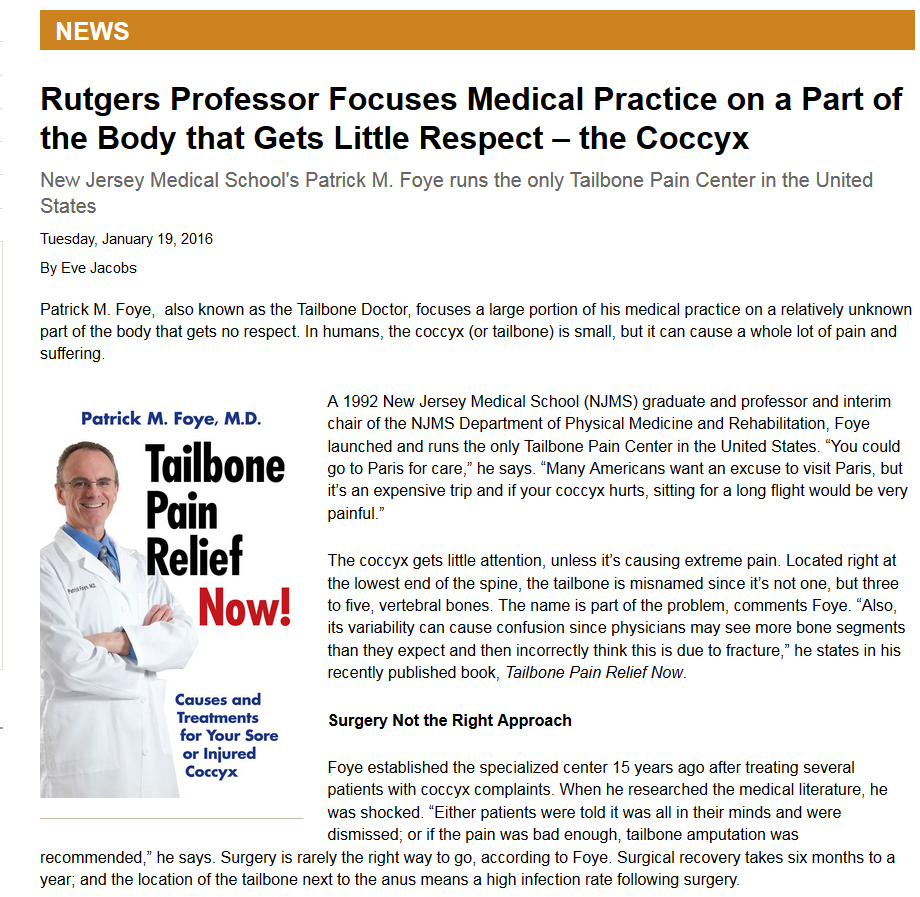
New Jersey Medical School’s Patrick M. Foye runs the only Tailbone Pain Center in the United States
Patrick M. Foye, also known as the Tailbone Doctor, focuses a large portion of his medical practice on a relatively unknown part of the body that gets no respect. In humans, the coccyx (or tailbone) is small, but it can cause a whole lot of pain and suffering.
A 1992 New Jersey Medical School (NJMS) graduate and professor and interim chair of the NJMS Department of Physical Medicine and Rehabilitation, Foye launched and runs the only Tailbone Pain Center in the United States. “You could go to Paris for care,” he says. “Many Americans want an excuse to visit Paris, but it’s an expensive trip and if your coccyx hurts, sitting for a long flight would be very painful.”The coccyx gets little attention, unless it’s causing extreme pain. Located right at the lowest end of the spine, the tailbone is misnamed since it’s not one, but three to five, vertebral bones. The name is part of the problem, comments Foye. “Also, its variability can cause confusion since physicians may see more bone segments than they expect and then incorrectly think this is due to fracture,” he states in his recently published book, Tailbone Pain Relief Now.
Surgery Not the Right Approach
Foye established the specialized center 15 years ago after treating several patients with coccyx complaints. When he researched the medical literature, he was shocked. “Either patients were told it was all in their minds and were dismissed; or if the pain was bad enough, tailbone amputation was recommended,” he says. Surgery is rarely the right way to go, according to Foye. Surgical recovery takes six months to a year; and the location of the tailbone next to the anus means a high infection rate following surgery.
Foye’s interest in coccyx pain intersected with the internet boom of the late ‘90s, when the number of web users worldwide jumped from 45 to 200 million in five years. As his proficiency treating the condition with injectable medications grew, New Jersey’s tailbone doctor invented several new treatment techniques and published his work in medical journals. Word spread rapidly among physicians, but it was a grateful patient – who had aggressively sought relief for two years before finding Foye – who insisted the tailbone doctor launch a website (www.TailboneDoctor.com) to let people know he was there. Several years ago, Foye posted informational videos to a YouTube channel, which has garnered more than 300,000 views. The website and the videos, as well as old-fashioned word of mouth, have driven patient visits to the Tailbone Pain Center into the thousands each year. Patients come from around the country and even from abroad.
“I’ve treated professional athletes, movie stars, musicians, construction workers, executives from Fortune 500 companies and mothers who can’t play with their kids on the floor – the spectrum of humanity,” he says. His patients range in age from 3 to 90 plus.
Unrelenting severe pain, right at the lower tip of the spine while sitting, is the primary complaint that brings patients to the center. Foye says that most X-rays of the lower spine are taken while the patient stands and rarely reveal coccyx problems. “In order to evaluate this condition, an X-ray needs to be taken while the patient is sitting,” he explains. Unavailable at most medical centers, the “sitting X-ray” may turn up a tailbone fracture or dislocation, an unstable tailbone joint, bone spurs, arthritis of the tailbone, or every once in a while, cancer or a bone infection. Mechanical pressure to the coccyx from a fall, giving birth, or prolonged sitting is commonly the cause.
While most of Foye’s patients had sought prior medical help, few found relief before coming to the center, where he provides specialized evaluations and treatments. He explains that a standard MRI of the lumbar area – a test often incorrectly ordered for tailbone pain – does not even include the coccyx; and that many coccyx pain patients are treated with physical therapy, which is often ineffective.
When the condition is properly diagnosed, treatments, including pillows that relieve pressure on the tailbone, local anti-inflammatory steroid injections, oral anti-inflammatory medicines and nerve blocks or nerve ablation, are usually successful. Surgical removal of the coccyx is sometimes necessary but is always a last resort, says Foye.
New Book – Free – Aims to Reach Sufferers
His book is one more avenue to reach a global population, according to Foye. While “seeing a patient in person” is always preferable, he says the end-goal is reaching as many tailbone pain sufferers as possible with accurate information. “I’m a physician and a medical educator,” Foye says. “I love teaching and helping others, so the book is perfect for that.” It’s available on Amazon but is currently free at www.TailbonePainBook.com.
Several hundred books were ordered within a couple weeks of publication; coccyx pain Facebook groups posted pages from the book on several sites; and he’s received emails from readers in many countries, including India, the UK, Sweden, and Germany. That makes Foye very happy.
“The book has a worldwide reach far beyond my own practice,” he states. “I want to empower patients to advocate for themselves.”
In July, Foye will be the only U.S. speaker at the first-ever international conference on coccyx disorders, which will be held in Paris.
This article appeared in the spring issue of New Jersey Medical School’s Pulse Magazine
To come to Dr. Foye’s Tailbone Pain Center:
Tailbone Pain Book:
To get your copy of Dr. Foye’s book, “Tailbone Pain Relief Now!” click on this link: www.TailbonePainBook.com
Book: “Tailbone Pain Relief Now! Causes and Treatments for Your Sore or Injured Coccyx” by Patrick Foye, M.D.
|
Book Now Available! Click on the book to get it now:
|