What is a Pilonidal Cyst?
- A pilonidal cyst is a collection of fluid and tissue, which can cause pain in the area of the sacrum and coccyx (tailbone).
- I recently published an online article and video discussing the symptoms and physical exam findings of Pilonidal Cyst.
- You can see that previous article and previous video here: Pilonidal Cyst Causing Tailbone Pain
The next step is to discuss the MRI findings of a Pilonidal Cyst.
- MRI is an advanced imaging test that can show details such as a pilonidal cyst.
- To reveal the video, click on the image or on the Link below:
 - Link to the Video: https://youtu.be/QAsZYiKyTyM
Here is the text from the video:
- This is a video just showing a pilonidal cyst on an MRI.
- So basically here, just to orient you, we’re looking at MRI slices.
- We’re looking at the sacroiliac joint on the right and over here on the left.
- And then here’s the sacrum.
- You can just see the start of the where you can see the sacral canal here and a little bit of the sacral hiatus.
- And if I start scrolling down we get down to lower sacrum right where the arrow is here.
- The computer is a little sluggish.
- But coming down here we can see the coccyx on cross-section here at oval-shaped white structure.
- And then here is the pilonidal cyst.
- So this bright white structure on this particular type of MRI image, where basically the white structure here is the pilonidal cyst.
- And then this white line extending to the surface (because out here this is the skin out here, coccyx there).
- So the pilonidal cyst has a “track” or “fistula tract” = the connection or tunnel coming down to the surface of the skin right there.
- Here you can just see the line, that’s the track.
- And the coccyx has now disappeared, so we’re actually now below the coccyx.
- So the pilonidal cyst was right at the back of the coccyx slightly to this side here.
- So this is the midline, so slightly to this side.
- This is actually slightly to the left of midline.
- I know that on the image it looks like it’s to the right, but that’s because the way the patient is laying, the way the image is taken.
- Things over here on this side of the screen will be on the patient’s right side.
- Whereas this side of the screen over here will be the patient’s left side so this is just slightly to the side.
For more information on Coccyx Pain, Tailbone Pain, go to: www.TailboneDoctor.com
To come to Dr. Foye’s Tailbone Pain Center:
Tailbone Pain Book:
To get your copy of Dr. Foye’s book, “Tailbone Pain Relief Now!” click on this link: www.TailbonePainBook.com
 Book: “Tailbone Pain Relief Now! Causes and Treatments for Your Sore or Injured Coccyx” by Patrick Foye, M.D.
Sometimes, Coccyx Pain (Tailbone Pain) can be Caused by a Pilonidal Cyst…
- A “cyst” is a collection of fluid. Think of it being like a tiny water balloon.
- A pilonidal cyst is a particular type of cyst that contains not only fluid but also hair and other debris.
- The most common location for a pilonidal cyst is within the skin behind the sacral or coccyx.
- A pilonidal cyst can cause local pain and tenderness.
- As the fluid from the cyst tries to escape from thus cyst, it creates a tunnel. The tunnel is referred to as a track. When that track reaches the skin you can see a tiny hole in the skin. This is a fistula tract.
- As fluid oozes out of the fistula tract, the patient may have a rash, redness, and itching of the skin in that area.
- As the fluid oozes out, there is now less fluid within the cyst, so the pain and pressure from the cyst may decrease.
- However, the fluid and pressure within the cyst may start to increase again, resulting in the pain coming back or increasing.
How Do You Tell the Difference between Pain Coming from a Pilonidal Cyst Versus Pain Coming from the Tailbone?
- Usually, a physician with experience will be able to tell whether someone’s pain is coming from a pilonidal cyst or if the pain is coming from the coccyx (tailbone).
- BOTH the tailbone and the cyst can cause local pain,, and pain that is worse with sitting.
- However, the symptoms of a cyst are different than coccydynia if the cyst has started oozing to the surface, since the patient may feel the fluid wetness, along with itchiness, and may notice redness or rash on the skin in the area.
- On physical exam, the physician should look directly at the skin over the involved area, specifically looking for the following signs of a pilonidal cyst:
- a small hole (fistula) in the skin
- redness of the skin
- rash of the skin
- wetness/dampness of the skin
- On physical exam, the doctor can press carefully over the coccyx (tailbone) and over the nearby areas, to assess whether the tenderness is over the bones of the coccyx versus over the nearby soft tissues.
- In some cases, medical imaging studies may be helpful and even necessary.
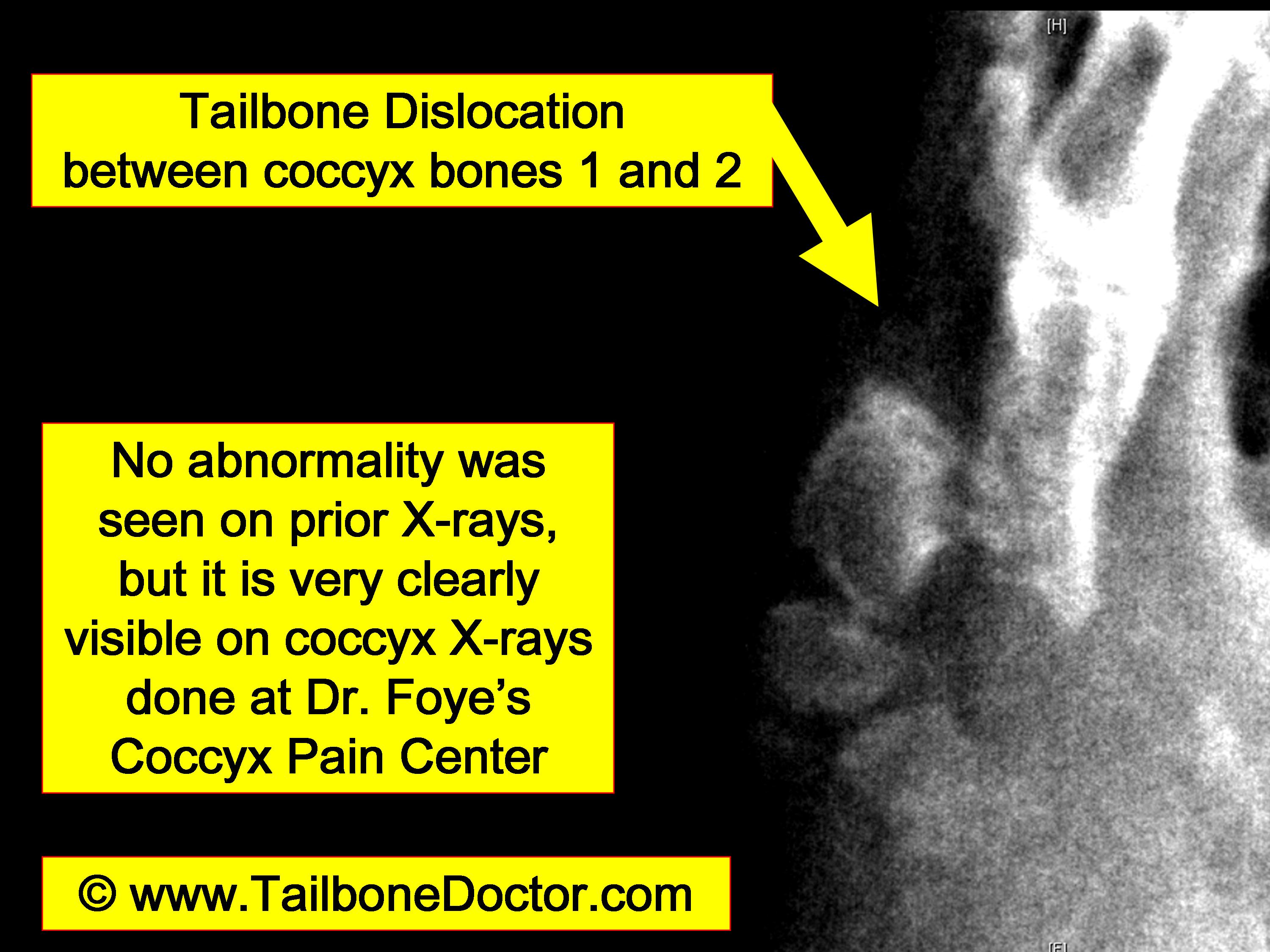
- X-rays can show abnormalities of the coccyx, including fractures, dislocations, arthritis, bone spurs, etc..
- X-rays generally will NOT show the pilonidal cyst.
- MRI can show BOTH the coccyx AND the pilonidal cyst.
- Unfortunately, medical imaging studies in the tailbone region frequently are NOT done correctly. They often fail to include the proper specific images that would be needed to assess the tailbone region. This is unfortunately true for x-rays, MRI, and CT scans. The ordering physician needs to be extremely clear in how they order the imaging studies, and the patient should encourage the radiology technician to make sure that the involved area is included and properly seen.
- Click here for a separate article and video on MRI revealing a Pilonidal Cyst at the Tailbone.
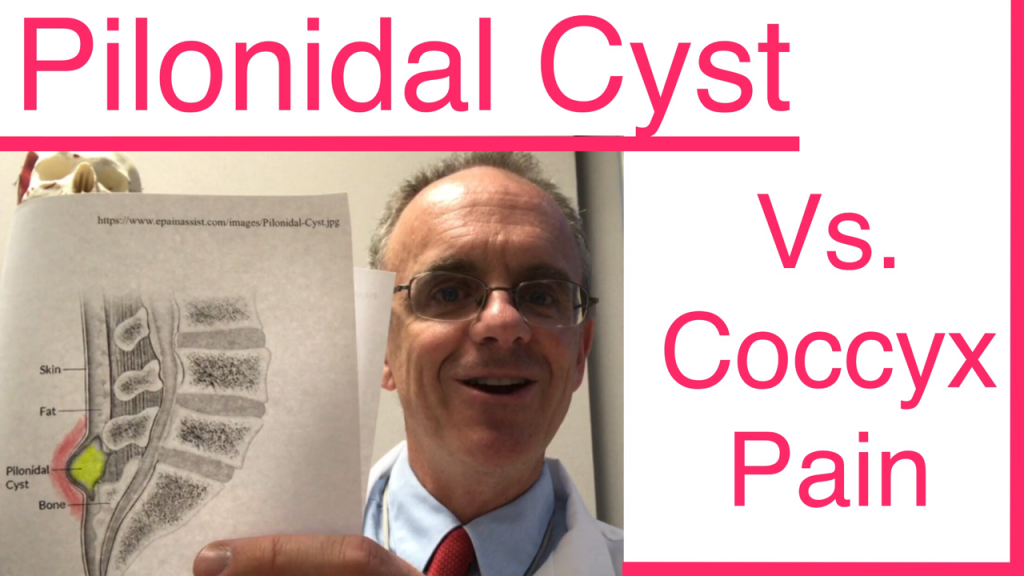
The Video below explains how to tell if pain is due to a pilonidal cyst versus due to coccyx problems.
Here is the text from the video:
- Hi, I’m Dr. Patrick Foye and I’m an M.D., or medical doctor, and I’m a medical school Professor and also the Founder and Director of the Coccyx Pain Center or Tailbone Pain Center here in the United States.
- You can find me online at www.TailboneDoctor.com.
- And this is really going to be just a short discussion about a pilonidal cyst and how you tell the difference between whether somebody has tailbone pain (or coccyx pain, coccydynia, pain that is coming from the tailbone itself) and distinguishing that from somebody who may have pain coming from a pilonidal cyst.
- So first of all what are the things that they have in common? Well a few things.
- Both of them are painful: a pilonidal cyst is painful and coccydynia is painful.
- Number two: where they’re located.
- Both of them tend to occur in the coccyx area, which is here at the lower end of the spine.
- So slightly above the anus, kind of at the back of the pelvis.
- The lower tip of the spine is the tailbone or coccyx.
- Pilonidal cysts tend to occur at the back of the sacrum and coccyx.
- So the area is generally very similar for both pilonidal cysts and for coccydynia.
- The other thing that they have in common is that both of them not only are painful but they can happen after a sudden trauma, but they can also happen without trauma.
- So that doesn’t help us to to tell the difference between the two.
- So both of them have pain, pain with sitting, with or without trauma, the location.
- All of that is very similar between the two.
- So then how can you tell the difference? The main thing is that a pilonidal cyst is different because it’s not down at the bony level the way that the coccyx is.
- So, again, for the tailbone or coccyx we’re talking about bone pain down at the coccyx itself and tenderness when you press typically onto the bone itself.
- Whereas a pilonidal cyst, as I’ll show you in the illustration, here is not down at the bone.
- It’s basically in the soft tissue structure.
- So you can see this swelling here.
- So often with a pilonidal cyst number one is that they’re not tender directly on the bone.
- Number two is that they may feel this lump or bulge because they have this collection of fluid a cyst is just a bag of fluid think about like a tiny water balloon just beneath the skin there.
- So that is the nature of a cyst (shown in yellow on the illustration here).
- And basically as that fluid starts to collect you get a lot of irritation you may get redness of the skin over the area so it starts to look something like that.
- And the other thing is that the cyst can start to try to find its way out.
- So the fluid and the pressure will start to build up and then the fluid starts to tunnel its way out towards the edge of the skin.
- And then at the skin you may see a little bit of a pimple over the area and it may burst open.
- And when it bursts open it oozes or lets out all of that gunk, that junk, that’s in there (all of that debris).
- What’s in there? Well there’s fluid as we mentioned.
- Often there’s debris like bits of hair can be in there as well.
- In fact, “pilonidal” means “nest of hair”. That’s the medical term.
- But basically all of that stuff starts to ooze out and when it does it’s really irritating to the skin.
- So again you’ll get more redness on the skin from a pilonidal cyst.
- You’ll get itching of the skin.
- You may get a rash of the skin just from being exposed to all of that stuff.
- And it may start to smell badly as well, especially if this is infected, in which case it’s not just a pilonidal “cyst” it’s a pilonidal “abscess” (an actual infection in the area) Those are the things about a pilonidal cyst.
- But with tailbone pain (coccyx pain) typically you don’t feel a substantial lump, you don’t get the redness on the skin usually, you don’t get the rash and the itching.
- Those are not typical for musculoskeletal, mechanical, coccyx pain or tailbone pain.
- Other things that are different: the treatments are very different.
- For treatment of tailbone pain (coccydynia) I have a whole aisle whole book you can get on Amazon.com or at www.TailbonePainBook.com There’s 272 pages in here all about workup and treatment for a tailbone pain.
- So that’s a lot, and I have a lot of videos and things online already about tailbone pain.
- But within the book I think I have maybe just two sentences or so about pilonidal cysts in the area, just to keep a lookout for them.
- So really the reason I’m doing this video is to add some additional info.
- I do not treat pilonidal cysts directly, so if you have a pilonidal cyst don’t make the the long trip to come and see me the way that many people do for tailbone pain.
- See your local primary care physician or perhaps a a local general surgeon.
- Usually they will be able to treat a pilonidal cyst very very well.
- The treatment really depends.
- If it’s mild sometimes just a soaking in a warm bath that or putting warm compresses can help that to ease some of that pressure or get rid of out some of that junk.
- If it’s really problematic one of the things you’ll want to do is certainly when you’re in consultation with your physician see about whether it makes sense to actually cut it open: “incision and drainage” there’s different techniques marsupialization, etc.
- There’s ways to cut it open and drain that junk out of there.
- So that hopefully not only do you relieve the pressure and get it out but that it does not come back.
- Because sometimes, with a pilonidal cyst, the fluid can come back and build up again.
- So the treatment then is really typically a relatively minor outpatient surgery to have that area opened up for a pilonidal cyst.
- If it’s infected then it’s a pilonidal abscess so things get a little more involved and certainly antibiotic treatment becomes important.
- So anyway that’s a couple of minutes just talking about what is a pilonidal cyst and how is it different from coccyx pain or tailbone pain.
- So that if you have a pilonidal cyst you should be treated or evaluated for a pilonidal cyst.
- And if you have a tailbone problem you should be treated or evaluated by someone with expertise in treating tailbone problems.
- If you want more information certainly you can find me online at www.TailboneDoctor.com Or certainly, you can get a copy of the book: there’s an e-book that you can get on Amazon.
- You can also get the hardcopy book on Amazon.
- At the time that I’m making this video, I’m actually giving away the hard copy of the book for free you just pay for shipping and handling.
- Only in the United States that’s printed paper book is available and for that you would get it through www.TailboneBook.com.
- So lots of ways for you to get information.
- I’m a big believer in empowering patients to learn as much as you can about your medical conditions so that in consultation with your treating physicians you can make the best decisions possible in your medical care.
- So that’s all for now I hope that was helpful for you.
- If you have questions or thoughts on this topic certainly post them down below and I look forward to reading them.
To come to Dr. Foye’s Tailbone Pain Center:
Tailbone Pain Book:
To get your copy of Dr. Foye’s book, “Tailbone Pain Relief Now!” click on this link: www.TailbonePainBook.com
Book: “Tailbone Pain Relief Now! Causes and Treatments for Your Sore or Injured Coccyx” by Patrick Foye, M.D.
Check out this lovely tailbone / coccyx illustration on the cover of our Literature / Arts magazine here at Rutgers New Jersey Medical School:

Full Link: http://njms.rutgers.edu/inside_njms/archives/2017q3/ArsLitBooklet.pdf
Great illustration by Stephanie Ruthberg, New Jersey Medical School. Well done!
To come to Dr. Foye’s Tailbone Pain Center:
Tailbone Pain Book:
To get your copy of Dr. Foye’s book, “Tailbone Pain Relief Now!” click on this link: www.TailbonePainBook.com
Book: “Tailbone Pain Relief Now! Causes and Treatments for Your Sore or Injured Coccyx” by Patrick Foye, M.D.
What’s the BEST Injection for Tailbone Pain, Coccyx Pain?
- Recently, another physician asked me, “What’s the BEST injection to do for patients who have coccyx pain (tailbone pain)?”
- There are multiple different types of injections that can help decrease or eliminate tailbone pain.
- But which injection is “BEST”?
- The answer depends on many factors…
- This video discusses this topic.
- To reveal the video, click on the image below or on the link:
 - Link: https://youtu.be/K5wayJ0LHF0
Here is the TEXT from the video:
- Hi. I’m Dr. Patrick Foye and I am an M.D., or Medical Doctor. And I am the Director of the Tailbone Pain Center, or Coccyx Pain Center. You can find me online at www.TailboneDoctor.com.
- And this is just a really short video regarding the question of what is the best injection to do for a patient who has tailbone pain?
- So let’s assume that other treatments were not working… medications by mouth and cushions and other things.
- And this question came up recently. I was speaking at a medical conference and one of the other physicians on the panel asked me after the session and said, “You treat a lot of tailbone pain, what is the best injection to do for these patients?”
- And I thought it was a really interesting question because it assumes that there is just one best thing to do. When really there is a variety of different types of injections that can be done for tailbone pain. And more importantly it depends upon the diagnosis.
- So, one of the things that unfortunately I see a lot is that patients have injections done without having a diagnosis first. And here at the Tailbone Pain Center I have treated thousands of patients with coccydynia, tailbone pain. And I ask them to bring with them their previous procedure notes if they have had injections in the tailbone region.
- And it is unfortunately very very common that injections have been done without a diagnosis being made first. And that is really important because the diagnosis is going to lay the groundwork for figuring out what type of injection, if any, makes the most sense to do in any given patient.
- And the comparison that I make is that it would be similar to going into the mechanic and asking, “What is the best thing to fix when somebody brings their car in with car problems?” And you would say well that is sort of a ridiculous question, it would depend what is the problem with the car. You would have to make the diagnosis first. Is it a problem with the fan belt, or the carburetor, or the spark plug, or the muffler, or whatever else maybe going on.
- And similarly at the tailbone, there are a number of different things that can cause tailbone pain. Everything from malignancies that can be life threatening, to bone spurs, to arthritis to fractures to dislocations to… very commonly we see patients with dynamic instability (which is an instability of the joints, which is the space in between the bones of the coccyx, where we can detect that by doing the x-rays while the person is sitting, compared with the position of the tailbone while the person is standing).
- And while they are sitting, that weight bearing may show that they have a dislocating joint at one particular spot within the coccyx. And, unfortunately, I have seen probably hundreds and hundreds of patients where this exact scenario has happened: where they have had previous injections done but they were not at the spot where the patient actually has their pathology.
- Or a patient may have a bone spur, a little bit of extra bone down at the lower tip of the coccyx. And that is where they have all of their pain. And yet I would read the procedure note and they had their injection done up at the top of the coccyx, the exact opposite end, not at the spot where they are having their pain.
- So, the short answer to the question, “what is the best injection to do for tailbone pain?” is: it depends. It depends what is causing the tailbone pain. For a longer answer I will refer you to online. This is just going to be a short video. But it is everything from there is coccyx steroid injections, there is particular types of nerve blocks and other things that can be done.
- I will put the link down below to some online articles that I have written on injections at the tailbone. There is also a whole chapter on injections in the tailbone, within my book that I have written, which is Tailbone Pain Relief Now!
- That is an Amazon, at least on the United States website for Amazon the book is available. Or at least at the time that I am doing this video, the book is available for free at the website www.TailboneBook.com. That is only if you live in the United States basically you just pay for shipping and handling. So that is www.TailboneBook.com, if you want to get a copy of the book. And there is an entire chapter in there specifically on the topic of injections for tailbone pain.
- So anyway that is my answer to the question of, “What is the best injection to do for patients with tailbone pain?” So I hope that this was helpful, I will post the links down below, (a) where you can find the book if you are interested in that, but also to some online articles that I have written about some of the different types of injections that are done in the treatment of tailbone pain.
- And if you want further information or to come and see me in person for an evaluation, the easiest way to find me is online at www.TailboneDoctor.com.
- So I hope the video has been helpful and all the best. Bye bye.
More information on Different Injections for Tailbone Pain:
To come to Dr. Foye’s Tailbone Pain Center:
Tailbone Pain Book:
To get your copy of Dr. Foye’s book, “Tailbone Pain Relief Now!” click on this link: www.TailbonePainBook.com
Book: “Tailbone Pain Relief Now! Causes and Treatments for Your Sore or Injured Coccyx” by Patrick Foye, M.D.
Can tailbone problems cause neck pain?
- Some tailbone problems can cause people to also have pain or stiffness in their neck.
- The most common form of this is due to abnormal sitting (sitting leaning forwards or to the right or left side, which is done to take pressure off the tailbone).
- A much less common way that tailbone problems cause neck pain is tightness or tethering of the dura. This video discusses this specific issue.
- To reveal the VIDEO, click on the image or the link below:
 - Link: https://youtu.be/u5pilrdyuv4
For more information, go to: https://tailbonedoctor.com
To come to Dr. Foye’s Tailbone Pain Center:
Tailbone Pain Book:
To get your copy of Dr. Foye’s book, “Tailbone Pain Relief Now!” click on this link: www.TailbonePainBook.com
Book: “Tailbone Pain Relief Now! Causes and Treatments for Your Sore or Injured Coccyx” by Patrick Foye, M.D.
Does Tailbone LENGTH cause Coccyx Pain?
- Here’s a recent video discussing whether the length of the tailbone results in coccyx pain (tailbone pain, coccydynia).
- To reveal the video, click on the image below, or on the link:
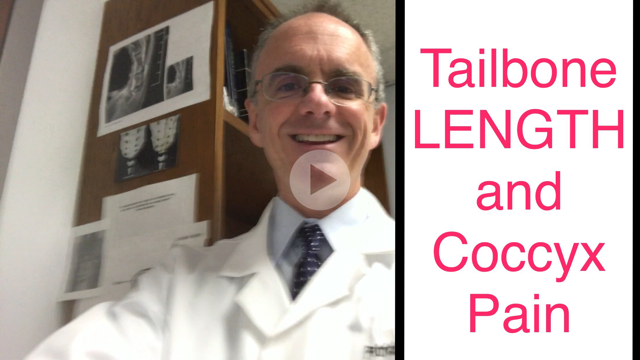 - Link: https://youtu.be/QH0bTOqSovc
Here is the text from the video:
- Hi. I’m Dr. Patrick Foye.
- I am the Director of the Tailbone Pain Center, online at www.TailboneDoctor.com
- This is a short video in response to a question about whether the length of the tailbone is correlated to whether somebody does or does not have tailbone pain.
- In general what’s more important than the actual length of the tailbone is the position of the tailbone and whether the joints are unstable.
- So there’s a lot of variability in terms of how long the tailbone is: in some patients there’s only three bones within the coccyx so three individual vertebral bones that are strung together. In some patients there’s four and some people there’s five.
- So there’s a lot of variability in terms of the number of bones and the overall length of the coccyx in general.
- But what becomes important is the positioning.
- So whether it’s a relatively long or short tailbone if it’s curved backwards or has a bone spur (a little bit of additional boning material on the lower end) that can be a source of pain when somebody sits, especially when they’re sitting leaning back.
- Or, whether again the tailbone is long or short overall, if there is instability within the joints (if the ligaments that normally would hold the joints in place are not doing their job of holding the joints in place, of holding one bone in relationship to the next) then again people can have tailbone pain, especially when they’re weight-bearing (which for the tailbone her coccyx is when they’re sitting, and especially again while they’re sitting leaning back).
- So, in general, more important than the actual length of the tailbone is the position of the tailbone, which can be seen on x-rays and MRI and CT scans.
- And more importantly because more commonly it’s whether there is instability whether the joints at the tailbone are not stable and that can be assessed mainly by doing sitting versus standing x-rays of the tailbone.
- So we look at the position that the tailbone is in while somebody is standing up and then we have them sit and lean back in their most painful position and then we repeat the x-rays and see what position the has moved into while they’re sitting and putting their weight on to the tailbone.
- So I hope that’s helpful just in answering the question of whether the length of the tailbone tends to be correlated with whether somebody does or does not have tailbone pain.
- If you’re looking for more information certainly you can find me online at https://tailbonedoctor.com
To come to Dr. Foye’s Tailbone Pain Center:
Tailbone Pain Book:
To get your copy of Dr. Foye’s book, “Tailbone Pain Relief Now!” click on this link: www.TailbonePainBook.com
Book: “Tailbone Pain Relief Now! Causes and Treatments for Your Sore or Injured Coccyx” by Patrick Foye, M.D.
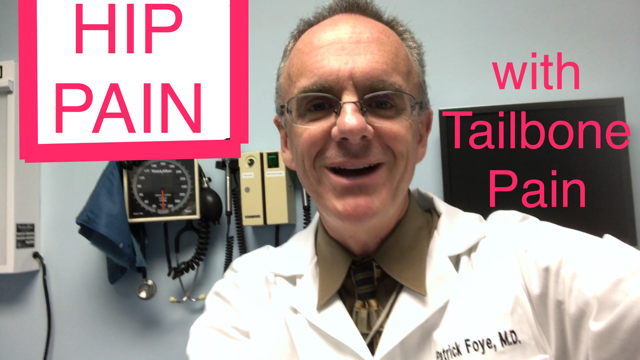
Coccyx pain (tailbone pain) can sometimes cause people to also have pain or stiffness in the hip region.
Text from the video:
- Hi, folks. This is Dr. Patrick Foye at the Tailbone Pain Center here New Jersey.
- This is just a short video to answer the question about tailbone pain in association with hip pain, meaning pain at the hip joint, or hip tightness.
- This was actually a discussion I had recently with the patient who was having a lot of tightness in her hips and she had been experiencing tailbone pain for a significant amount of time.
- The general issue as I see it is that when people have tailbone pain tend to sit abnormally because the body is smart and it’s looking to avoid pain.
- So people will sit where they’re leaning towards one side or the other. Or they’ll sit bending forward your leaning forwards so that the tailbone is not making so much contact with the chair that they’re sitting on.
- But the downside of that is that if you’re sitting for a prolonged duration of time, sitting forward or leaning to one side, for hours at a time, it’s very very common that you would start to develop stiffness and tightness within the hip joints, because of how you’re sitting.
- I can kind of show you this now if you’re sitting leaning forwards your flexing at the hips and therefore you’re not going to be having the normal neutral hip position the way that people without tailbone pain would sit.
- So it’s not uncommon to see that combination (hip symptoms along with tailbone pain).
- I certainly see a number of patients where they’ve had tailbone pain for a while and because of abnormal sitting other parts of the body, including the hips, will start to hurt.
- In general, if the tailbone was the primary problem than the goal is to treat the tailbone pain and get the tailbone pain under as good control as possible. Then, often, those other areas will start to quiet down as the person can sit more normally.
- But sometimes the pain and tightness and stiffness and decreased range of motion may persist in those other areas and actually need specific treatment above and beyond what we’re doing specifically at the tailbone.
- So, anyway, that’s just a quick video with my thoughts and comments on hip joint tightness and pain and stiffness seen sometimes in combination for patients were suffering from coccydynia (Ward coccyx pain, tailbone pain).
- Anyway, I hope that’s helpful information.
- If you want more information you can find me online at www.TailboneDoctor.com.
To come to Dr. Foye’s Tailbone Pain Center:
Tailbone Pain Book:
To get your copy of Dr. Foye’s book, “Tailbone Pain Relief Now!” click on this link: www.TailbonePainBook.com
Book: “Tailbone Pain Relief Now! Causes and Treatments for Your Sore or Injured Coccyx” by Patrick Foye, M.D.
Why can’t you just treat coccyx pain or injuries the same way you would treat other musculoskeletal injuries?
There are 4 main reasons:
-
#1: You can NOT put a CAST on the tailbone.
- Unlike an injury to your arm or leg, you can not put a CAST on your tailbone.
-
#2: You can NOT use a SLING for the tailbone.
- Unlike an injury to your arm, you can not use a SLING for your tailbone.
-
#3: You can NOT use orthopedic hardware on the tailbone.
- Unlike an injury to your arm, you can not use orthopedic hardware on the tailbone.
- For arm or leg injuries, orthopedic hardware includes using plates and screws to hold the bones in place. But the bones that the tailbone are very small and fragile, and do not have the sturdiness or “bone stock” for the screws, plates, or rods to be held in place. The small bones of the coccyx may crumble if you tried to put a sturdy screw into them.
-
#4: Ideally, the tailbone needs to be able to MOVE.
- Even if you could use orthopedic hardware or other approaches to fuse the tailbone together, that may create new problems. Normally, the tailbone needs to be able to move a small amount. When we sit, the tailbone normally flexes forward so that it is out of the way while we are sitting. Fusion would prevent that, which could potentially make the pain even worse.
Fortunately, most people with coccyx pain (tailbone pain, coccydynia) respond well to non-surgical treatment, including the use of cushions, medications, and local injections.

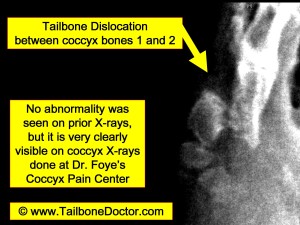 Severe Tailbone Dislocation on coccyx X-ray, causing coccyx pain, tailbone pain, coccydynia To come to Dr. Foye’s Tailbone Pain Center:
Tailbone Pain Book:
To get your copy of Dr. Foye’s book, “Tailbone Pain Relief Now!” click on this link: www.TailbonePainBook.com
Book: “Tailbone Pain Relief Now! Causes and Treatments for Your Sore or Injured Coccyx” by Patrick Foye, M.D.
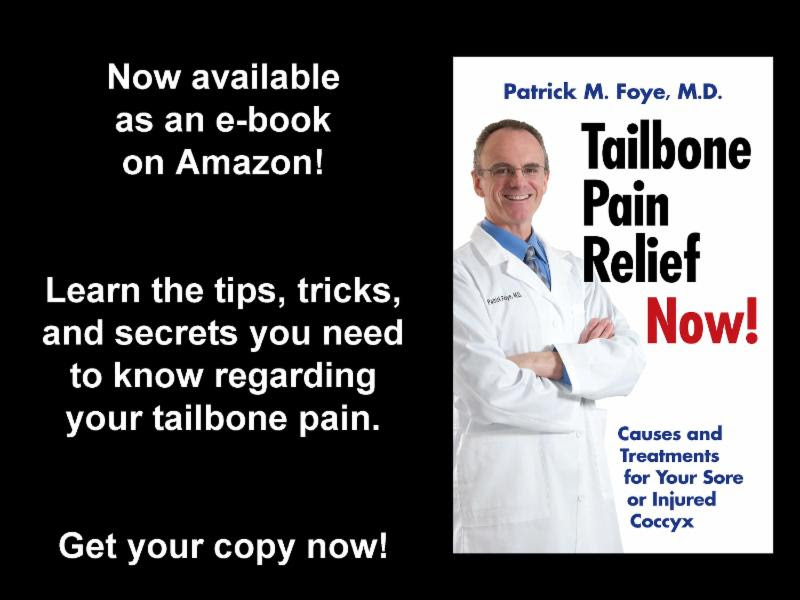
Get your e-book version of Dr. Foye’s internationally acclaimed book, Tailbone Pain Relief Now!
- Yes, this week we are excited to announce that this book is now also available in electronic, e-book form, on Amazon.com, at a fraction of the cost of the paper book.
- Learn the tips, tricks, and secrets you need to get an accurate diagnosis for your coccyx pain and the best possible treatments.
- The book contains 31 chapters, 272 pages, providing crucial information for people suffering with tailbone pain (coccyx pain).
- It is written in plain language, so it is easy to understand by people who do not have any medical training.
- The book has an impressive 5-star rating by readers on Amazon.
- You can get your copy of the book in the format of your choice: either as a printed paperback or as an e-book. Available internationally.
- The e-book can be read on your Kindle, or via Amazon’s other options, including on your Windows or Mac computer, iPod Touch, iPad, iPhone, Android, Windows Phone 7, or BlackBerry.
To come to Dr. Foye’s Tailbone Pain Center:
Tailbone Pain Book:
To get your copy of Dr. Foye’s book, “Tailbone Pain Relief Now!” click on this link: www.TailbonePainBook.com
Book: “Tailbone Pain Relief Now! Causes and Treatments for Your Sore or Injured Coccyx” by Patrick Foye, M.D.
VIDEO: Medical Books often FAIL to cover Tailbone Pain Coccyx Pain
See-the-VIDEO:
Transcript of the video:
- Medical Books often Fail to Cover Tailbone Pain.
- Patrick Foye, M.D. www.TailboneDoctor.com
- Okay. Hi. I’m Dr. Patrick Foye, the Director of the Tailbone Pain Center in New Jersey, United States, online at TailboneDoctor.com
- And I’m here at a medical conference, actually in New Orleans, Louisiana, right now.
- And one of the things I was noticing just looking at some of the different textbooks (medical textbooks: musculoskeletal medicine and pain management) is how few of them have anything about tailbone pain.
- So I’ll show you that on some of the books inside right here.
- Okay, this is a book called Physical Diagnosis of Pain, by Steven Waldman, who is well respected for publishing in pain management textbooks.
- And if we look at the index here in the back of the book… index and going under the letter “C” of course for coccyx pain, we see that it is NOT listed at all.
- So then you might think that Dr. Waldman’s textbook of “Uncommon” Pain Syndromes might include this. But again if we go to the index of this one… again we see that going alphabetical here again.. coccyx is pain is NOT listed at all.
- Okay, this book is on “i-Spine” on interventional spine care. You know that the coccyx is part of the spine. But if you go to the index and we look under “C”… we’ve got Cervical, we’ve got Chest, we’ve got Collagen, but NO coccyx.
- Here’s another example: this one is a book called Orthopedic Imaging by Greenspan, who I can tell you is a well respected author of musculoskeletal imaging books. This book is over eleven-hundred-pages-long and again if we look back to the index and we look under C… we see that the coccyx is NOT included at all! There’s NOTHING about the coccyx in this over 1,100 page book about orthopaedic imaging. Okay, this one is called Fundamentals of Pain Medicine, by Hoppenfeld, also a well-known author in musculoskeletal books. And again if I swing back to the index under “C” and look here there’s nothing on coccydynia within this.
- Okay, this one is actually a terrific textbook Essentials of Musculoskeletal Care. They’re up to version 5. I had version 1 when I got out of residency myself 20 years ago. It’s actually a fantastic book that’s put out by the American Academy of Orthopaedic Surgeons.
- So here is the book. But again if we go to the index section here and if we look under “C” for coccyx or coccydynia…
- Basically, you can see that it does not include anything about coccydynia or the coccyx.
- So I guess this orthopedic textbook is saying that the coccyx is not one of the “essential” areas of musculoskeletal care, unfortunately.
- Okay, so hopefully that gives you just some idea about how many many musculoskeletal and pain management medical books and textbooks and procedure guides and all of those kinds of things unfortunately contain little or NOTHING ABOUT TAILBONE PAIN.
- So, Again just my perspective as a doctor who treats many many patients with tailbone pain. It amazes me how little is known by medical professionals and maybe it’s no surprise because often they’re not taught much about the tailbone in medical school or in residency or fellowship or even in the medical textbooks that they are reading.
- So, alright that’s all for now, if you want more information on tailbone pain you can certainly find me on my website at TailboneDoctor.com
- Bye, bye.
- Or to get your copy of the book that I’ve written on tailbone pain, go to TailboneBook.com
- This is 272 pages, 31 chapters, all about coccyx pain (tailbone pain), diagnostic workup, treatment, etc.
- Largely I wrote this because there was not much published in the medical literature.
- Go to www.TailboneBook.com.
- Thank you.
To come to Dr. Foye’s Tailbone Pain Center:
Tailbone Pain Book:
To get your copy of Dr. Foye’s book, “Tailbone Pain Relief Now!” click on this link: www.TailbonePainBook.com
Book: “Tailbone Pain Relief Now! Causes and Treatments for Your Sore or Injured Coccyx” by Patrick Foye, M.D.
|
Book Now Available! Click on the book to get it now:
|